Friday, June 29, 2012

Newhaven – The Princess Parrots


We only stayed at Newhaven for 5 nights but it is such a magic place, and we did and saw so much, that I have decided to split my visit into two entries. The first will be about the Princess Parrots and the second about the rest.
*     *     *     *     *

At the entrance gate
So, what does it take to get you out of the house in winter? How about the prospect of seeing Princess Parrot, Banded Whiteface, Rufous-crowned Emu-wren and Grey Honeyeater, all in one trip? It worked for me. Back on the 7th of June Melbourne was cold and windy. Lorna Mee emailed from the Hunter wanting to know if I want to go on a trip to Newhaven. I thought about the offer for a full seven seconds – sun, warmth, mega-birds – and emailed back that yes, I would love to go.

Lake Eyre and a river on the flight from Melbourne
We met in Alice Springs on the 14th, a week later, and Jim had arranged to hire a Troopie and camping gear from Kevin Reid at Central Car Rentals. It seems that this was the only 4X4 left and what a 4X4 it turned out to be! It only had 4860 km on the odometer when we picked it up so it was all shiny and new. And it was not just a Troopie, it was a V8 diesel Troopie. We kept the speed to between 80 and 100 kph on the Tanami Track and for the trip, Alice to Alice including our time in Newhaven, a total distance travelled of 1350 km, we used 150 litres of fuel.

Typical birder's car - all doors open
We thought the Troopie would be more than we needed but with a fuel capacity of 180 litres it was perfect for 5 days out at Newhaven as we had plenty of fuel without worrying about getting back to the Tilmouth Well Roadhouse to refill. The driving time from Alice to Newhaven, at birdwatching speed and with stops, is about 6 – 7 hours. Tilmouth to Newhaven is about 160 km.

The camp site and our swags
We arrived at about 1600 and the campgrounds were wonderful. The volunteers keep the fireplaces stocked with cut firewood that they collect from trees that have fallen across tracks, and the bathrooms are spotless, they even have hot water, hand towels and bathmats – how luxurious is that! We had rented swags and it was the first time I had slept in one. The nights were cool in all ways with temperatures around 2ºC and no clouds so that the stars shone brightly. On two mornings we even had the crescent Moon, Venus and Jupiter clustered together on the horizon. It was magical. During the days the temp got to about 26ºC and there was no wind at all.

Moon conjunct Venus and Jupiter above them
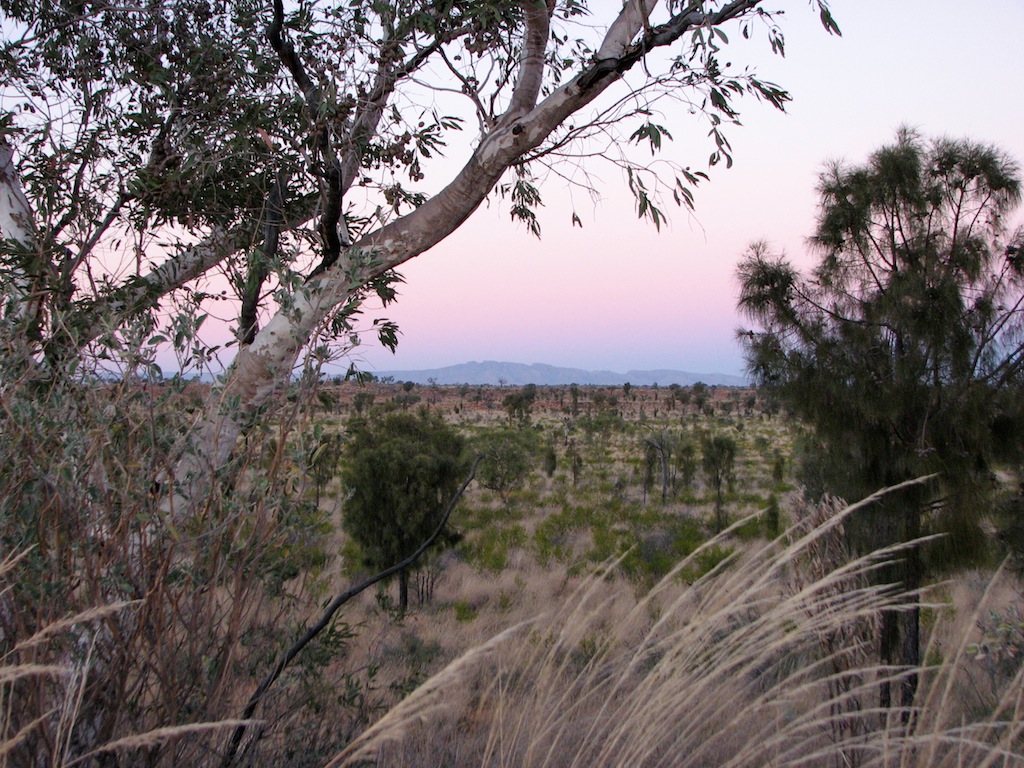
The next morning we met Peter and Toni at 0600 and followed them to the far corner of Newhaven where the Princess Parrots have been seen. Most of the drive was in darkness but by 0700 when we arrived at “the spot” the sun was just appearing over the dunes and the country shone in all the pastel shades of a desert dawn. The parrots gave us a slow start and all we got in the first 2 hours was a distant view of 18 +/- as they flew along the horizon.

Mt Liebig in the early morning light.

Ghost Gums in the morning light

From the top of the dune where we saw the flock of parrots
One good thing about this slow start was that we ended up walking out across the dunes for about 7 km as we looked and listened without luck. We saw many of the desert plants though, including Green Birdflower, Crotalaria cunninghamii, the flowers of which the parrots have been seen to feed on. It seems that they pick the flowers off and chew the succulent tip. With the assurance of Toni that it wasn’t poisonous I ate one and it tasted just like a fresh snap-pea. There were lots of other plants just starting to flower including a wattle that had the strongest, sweet-peppery scent I have ever smelt from a flower; how I wish I could be there when the whole bush was in flower.

If the birds won't come to you ....

Green Birdflower, Crotalaria cunninghamii. Fresh picked flowers lay under the bush
Crotalaria cunninghamii flowers
We then moved on to a second spot where Peter and Toni had seen the birds and finally two showed up and gave us some good looks as they perched in front of us. They are evidently harder to find now than they have been and Peter and Toni said the reduction in sightings seemed to coincide with an increase in the number of budgies. It may also just be that the flocks are breaking up into pairs and the birds are quieter and less noticeable.

Half asleep in the morning sun
Multiple shades of green in the upper wing.
Such a beautiful bird

On the second morning we went out again to give a ride to a birder who had arrived in an X-Trail. We certainly did not complain about going out a second time and once again two birds finally arrived and fed on the ground in company with a pair of Australian Ringnecks. They were also very interested in a tree that had a hollow and spent some time checking it out. They were very confiding but we did not push them, relying on scopes, binoculars and long camera lenses.

Spellbound watchers
There was a potential nest hole in this tree
And after the birds came a cup of tea, Toni's home made cookies and a chat
There was a lot of other bird life in the area but it got scant attention as we watched the parrots. I would have loved to go back for a third morning and concentrate on these birds but time was limited and there were other places to go and other birds to see. A second visit to Newhaven is now on my mandatory to-do list.

Major Mitchells Cockatoos

A flock of Crested Pigeons
Peter and Toni have now left Newhaven so the guided trips have stopped but I do hope that some other volunteer carries on documenting the bird’s habits as Toni and Peter have been doing. They have gained a lot of information about the parrots and it would be a real shame if the work stopped just as it looks like the birds might be going to nest.

When they stretch their necks more pink shows and it goes a darker colour
The Yellow-throated Miners showed no respect
The tree where the first PP landed with the dunes behind


All images are copyright and may not be used without written permission.

Thursday, May 24, 2012

Raptors etc at Werribee


Last week I came down with the worst cold ever. I was feeling so bad I couldn’t even go birding on Sunday with my friend Joy. On Sunday night Joy sent me a stunning photo of a Spotted Harrier that she had found at the WTP, where she had gone without me. I was seriously disappointed at having missed a fun day of birding and a great bird.

On Monday morning the weather was sunny and calm so I rationalized that even though I was still suffering from a cold, all hacking coughs and unruly snuffles, I could turn the heat on in the car and be as warm as I would be in the house. I got dressed, made a thermos of tea and headed out. I really needed to see that harrier. 

Spotted Harrier
Based on the background in the image Joy had sent me I headed to the Western Lagoons area first. As I was unlocking the gate to go in the Spotted Harrier cruised leisurely over the pond in front of me. It was going to be a good day!

With the bright yellow cere showing well as the bird banked toward me
I ended up spending most of the day at the Western Lagoons because the birding there was so good, especially for the raptors. All told I had nine species over the ponds, surrounding paddocks and foreshore. There was the young Spotted Harrier that was working along the spit and at the north end there were at least five Whistling Kites.

A dorsal view
Whistling Kite
A first-year Black Falcon was working down by the entry gate and Swamp Harriers were everywhere. A Black Kite was at the Murtcain outlet as were Brown Falcon and Black-shouldered Kite. The Black Falcon came as a real surprise, both to me and to the Black-winged Stilts I was watching. I was being very quiet but suddenly the stilts all froze and stared in my direction. The next moment they were in the air and as I looked up I could see why. The falcon had appeared low down and was coming fast toward the pond where the stilts had been feeding. The stilts escaped but watching the falcon on a hunting run was a real treat.

Black Falcon. Not the best photo but it was so fast ....
Black Falcon. Note the pale face of the young bird.
Black-winged Stilts flushed by the falcon

A White-breasted Sea-Eagle was resting on driftwood on the spit and finally there was a Nankeen Kestrel on 29 Mile Rd. 
White-breasted Sea-Eagle
Nankeen Kestrel
I missed the Wedgies, Brown Goshawk and Hobby that I have seen down there earlier this year so I will have to go back. I mean 9 raptors in a day was special but 12 would be astounding. And of course there is sometimes a Peregrine at WTP too, but getting that as well in one day would just be greedy (smile).
Brown Falcon
Black-shouldered Kite
Black Kite
Black Kite being harassed by a very upset Magpie-lark
Swamp Harrier. One day I will get a nice photo of one on the ground
Black-fronted Dotterel leaving tracks in the glutinous black mud

Very shy European Goldfinch, just before they flew
Eurasian Skylark

Zebra Finch numbers at WTP have exploded over the last few years and they are now seen everywhere


This Little Raven just begged to have its photo taken

and this White-faced Heron didn't really want to hang around
To me this is a Mountain Duck, and always will be.
Musk Ducks. First you see them ...

.... then you don't


Saturday, May 12, 2012

There is more to birdwatching than just looking at birds.


A while back a friend said my camera was taking me away from “birdwatching” and into “bird photography”. I disagreed on the grounds that the camera was just an aid to the watching. With my eyes not showing me what her younger, super-human vision shows her I replied: “I want to have a photo of some of the birds I see. I want to learn more about the birds I see, not just look at them. I want to use the photos to help me broaden my knowledge of birds and maybe, just occasionally, find something that can be added to our overall knowledge about birds. So, it is still the birdwatching that drives me, not the photograph.”

Here is what I mean about seeing more when I birdwatch with a camera:

1) Early on, with my first dslr camera, I was trying to get a photo of an Eastern Whipbird. I sat hidden and waited for one to come to some birdseed that had been set out. The bird finally appeared and started feeding. As I watched and took photos I realised that the bird was only using its left foot to hold the seeds, never its right foot. I searched through the birding journals and found references to research on Eastern Whipbirds that suggested the same thing, but there were no photos.
Eastern Whipbird holding seed in left foot
2) Back in 2010 I saw a Satin Bowerbird that had moulted all its head feathers. I thought this strange but then the next day, 200 kms away, I found another one in the same condition. Now that was interesting. But then, when we were on Norfolk Island this year, many of the European Blackbirds were walking around with bare heads. Fascinating. I wonder if it is a normal moult or do these birds have a dietary deficiency?
Bald Satin Bowerbird
Bald Common Blackbird

3) In the sporting world, baseball for example, players are known to paint a black stripe on their cheekbone. It is meant to stop the glare of the sun reflecting off the cheek and interrupting their view of the ball, target, whatever. In birds though I am noticing a reverse strategy. Lots of bird species have either a row of white dots or a white line on or near the bottom eyelid. Now what on earth could be the reason for that?
Reed Warbler

Shy Heathwren

White-browed Scrubwren

Black Noddy

Brown Noddy

Australian Spotted Crake

4) Down in a wonderful coastal park in Victoria called Croajingolong there is a slope of heath-land overlooking Bass Strait where I know I can find Southern Emu-wrens. With the aid of my camera and some patience I now know that Southern Emu-wrens have whiskers like a cat, white dots below the eyes and yellow pads on the bottom of their feet. Now isn’t that fascinating!
Southern Emu-wren, female

5) At Werribee on the 29th April we found a lone Curlew Sandpiper. This is very late in the year for a Curlew Sandpiper to be around the Melbourne area and as the bird did not flush as we drove up to it and stopped I got a series of images over 4 minutes. We then drove quietly away and left the bird standing beside the track. When I put the pictures on the computer I could see that in every photo the bird’s eyes were clouded over, as if the nictitating membrane was stuck over them, or the bird was unwell. Could partial blindness be the reason the bird did not migrate with its fellows?
Curlew Sandpiper

And as I was in the process of writing these thoughts, I came across an item from the ABA blog in America. The author’s motivation is different from mine but his comments relate directly to what I am trying to say – there is more to birdwatching than just looking at birds. If you are interested, have a look at 
http://blog.aba.org/2012/04/open-mic-resources-for-a-displaced-birder.html

Oh, and by the way, not that I would admit it to my friend, it is rather fun taking pictures of birds and taking the pictures has changed my birding trips, just a bit (smile).

All images © Jenny Spry not to be used without written permission

Tuesday, May 8, 2012

Scaly-breasted Lorikeets (almost)

Knowing that Swift Parrots sometimes hang out at Woodlands Drive in Ocean Grove (Vic) we drove down last Sunday and started looking. We didn’t find any Swifties but many of the eucalypts were in heavy flower and the lorikeets were everywhere. Musk and Rainbow Lorikeets were in the majority but a few Purple-crowned were mixed in with them.
Musk Lorikeet - taken at Ocean Grove

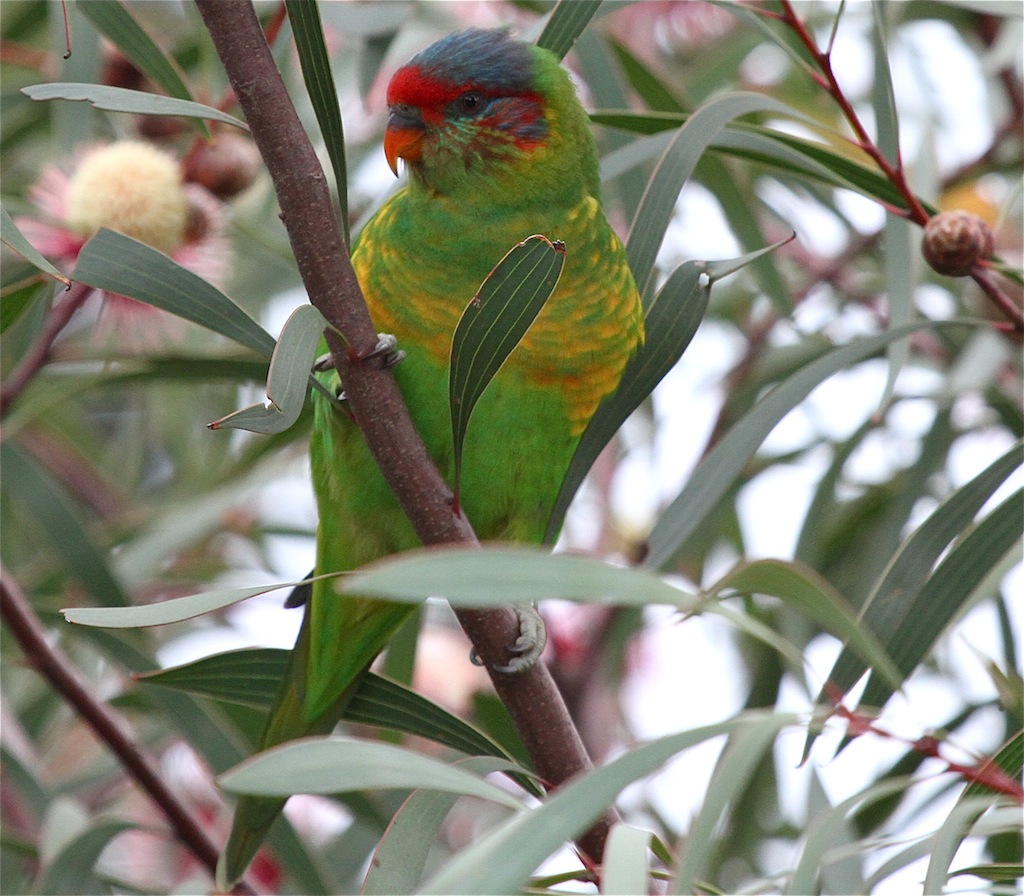
Amongst the flocks we also found what looked like Scaly-breasted Lorikeets and I thought I had a new bird for this year’s list. It was not to be though because as we looked we saw that what we had first thought were Scaly-breasted Lorikeets had all actually hybridised with either Rainbow or Musk Lorikeets.
An old photo of a Rainbow Lorikeet - not taken at Ocean Grove

The Musk/Scaly-breasted Lorikeets hybrids had the bright red foreheads and ear coverts that go with the Musks. They had also taken on some of the Musks darkness at the base of the bill.
Scaly-breasted/Musk Lorikeet hybrid

Those that had crossed with the Rainbows had purple head feathers infused with the green of the Scaly-breasted. The breast “scales” also appeared to be more orange than yellow.
Scaly-breasted/Rainbow Lorikeet hybrid


All images are © Jen Spry unless otherwise stated and may not be used without written permission

Hobbies


Over the last 50 or so years I have had four pastimes that have stayed with me one way or another. They are birdwatching, taking photos of birds, being out on the water in boats, and writing.

I have been a birdwatcher since I was about 10 when Graham Pizzey showed me my first Tawny Frogmouth in a coastal tea-tree. I took my first bird photos in about 1956 with the family Box Brownie. The subject was a Superb Blue-wren in a tea-tree bush. The result was a slightly darker grey patch, just visible in the middle of a mass of grey twigs. In about 1966 I bought a Pentax Spotmatic 35mm camera but the expense and frustration of getting two or three good bird images from a role of 36 soon put paid to that.
Tawny Frogmouths - not the original one, but taken at the You Yangs

From when I was very young family holidays usually included some sort of fishing from small boats on lakes and bays. Later on I had friends with whom I could go sailing and this eventually led me to the joy of pelagic birdwatching. My first boat trip specifically for pelagic sea-birding was to sail in July 2001 from London to Melbourne on a containership. This was followed by my first Port Fairy pelagic trip in December 2002. Many more trips followed to where I have just done my 29th pelagic trip.

P&O containership New Zealand Pacific. Sadly this ship has now been sent to the scrapyards in India

Wandering Albatross off Eden, NSW

My first published bird article was back in 1975. In 2000 I met my friend Joy and willingly jumped feet first into manic birding. In 2003 I bought a small digital camera with a 4X zoom lens and learnt again the pleasure of photographing birds, with one MAJOR added benefit – the DELETE button. In early 2004 I started putting reports on Birding Aus.
Onboard the MV Flyingfish on the way to Ashmore Reef, 2009

Now I have finally entered the 21st Century with this blog, and all my photos, writing and birdwatching are coming together in one place. So, how good is it when you can have four hobbies and link them all together, do them all at once and not have to apportion time between them? Yeah.
The Spirit of Enderby serenely at anchor, Campbell Island ...
... and the next day in a full gale at 53º South Latitude on the way to Macquarie Island


All images are © Jen Spry unless otherwise stated and may not be used without written permission